
What Is Private Market Investing?
Private market investing refers to the investment in privately owned companies versus publicly owned companies. Private market investments could be equity or debt investments in companies that are not traded on public exchanges.
Private market investments provide access to innovative, high-potential companies in their early stages of growth, thus offering investors a set of investment options that can complement public market assets and potentially provide opportunities for higher long-term returns. These investments can be made directly but are most often made by funds as part of a larger portfolio.
Private markets have grown significantly in recent years as investors seek alternatives to public markets for greater diversification and access to investment opportunities unavailable in public markets.

Why Invest in Private Markets?
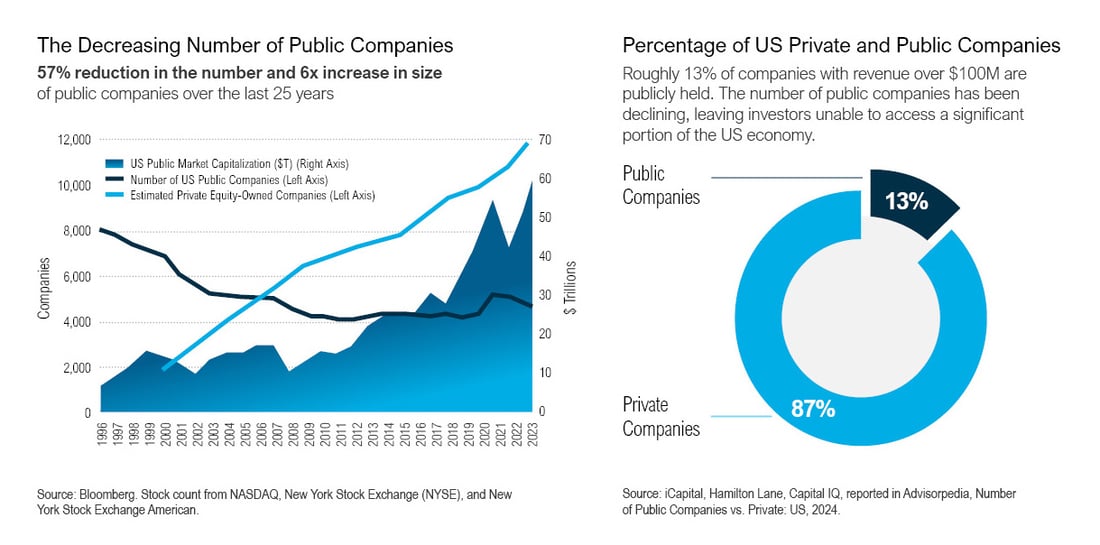
Investing in private markets creates new opportunities for investors. That’s because there’s a larger universe of available investments in private markets than in public markets. There are more than 18,000 private companies in the US with annual revenues over $100 million.1
Meanwhile, the number of public companies in the US has fallen by nearly half since the late 1990s. After peaking at more than 8,000 companies in 1996, the number of domestically publicly traded companies available on the major US stock exchanges has declined to less than 4,000.
1 Source: S&P Capital IQ and Statista; data as of Q1 2023, NYSE and Nasdaq: listed companies comparison Q1 2023 | Statista
The Decreasing Number of Public Companies
More growth and potential opportunity are occurring in the private markets.
Why Are There Fewer Public Companies Today?
Mergers and acquisitions between public companies have contributed, as well as a wave of bankruptcies. But more telling are these additional reasons:
-
A decrease in the number of Initial Public Offerings (“IPOs”) since 2000;2
-
An increase in the number of public-to-private transactions;3 and
-
More and more companies are simply choosing to remain private.
2 Source: Stock Analysis, IPO Statistics and Charts – Stock Analysis
3 Source: Dealogic, Private equity deal-making hits 10-year high |Dealogic Insights
Why More Companies Are Choosing to Remain Private
The challenges (versus the reward) of becoming a public company today have tilted the scales in favor of staying private. These challenges include:
-
Additional governance requirements
-
Heightened accounting and auditing requirements
-
Higher operating costs
-
Pressure to deliver quarter-by-quarter performance results to shareholders
What Are the Potential Benefits of Private Market Investing?
Investing in private markets can offer unique benefits that are not typically available in public markets. While private market investments come with higher risks and longer time horizons, they also provide opportunities for diversification, higher returns, and access to unique investment opportunities.
Key reasons and benefits of investing in private markets:
Access to unique opportunities:
-
Private markets allow investors to access opportunities that are not available in public markets, such as early-stage startups, private companies, and infrastructure projects.
-
Investors can participate in industries or sectors with high-growth potential before they become publicly accessible.
Potential for higher returns:
-
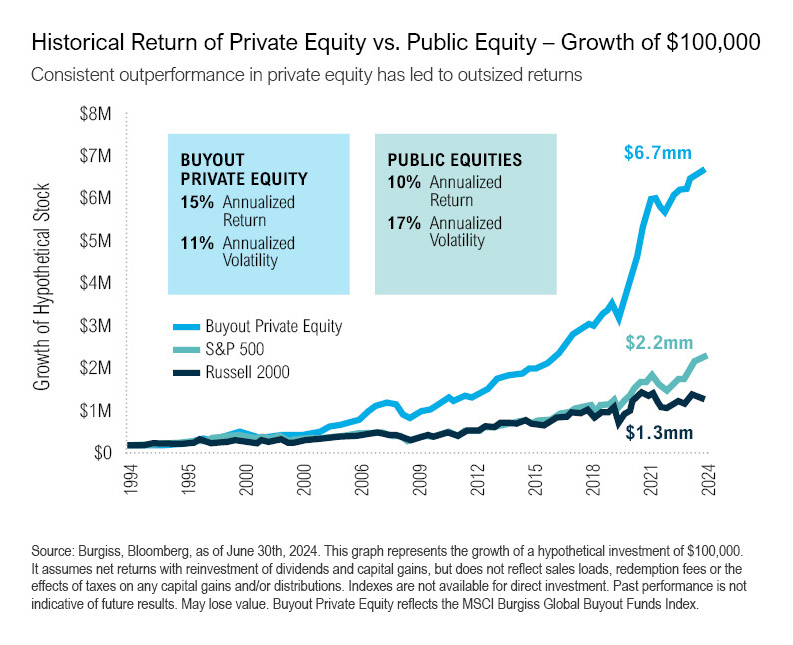
Private market investments often have the potential to generate higher returns compared to public market investments. Investors can benefit from the growth of private companies, operational improvements, or successful exits (e.g., IPOs or acquisitions).
-
Because private market investments are less liquid, investors are often compensated with higher returns (known as the "illiquidity premium") for committing their capital for extended periods.
Diversification:
-
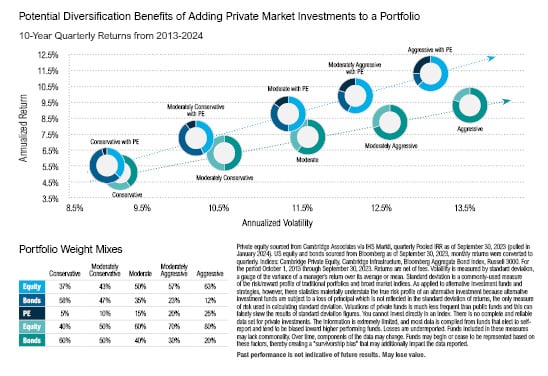
Private markets provide exposure to asset classes that are less correlated with public markets. Correlation is the degree to which two securities, asset classes, or markets move in relation to each other
-
This diversification can help reduce overall portfolio risk and improve long-term returns.
Reduced volatility:
-
Private market investments are not subject to the daily price fluctuations of public markets, which can reduce portfolio volatility.
-
This can be particularly appealing during periods of public market instability.
What Are the Potential Risks?
Before investing, it’s always important to understand the risks of any investment decision, and private market investing is no exception. Some of the risks of private market investing to consider include:

Illiquidity
Unlike securities in the public market that are easily bought and sold on a daily basis, private market funds, usually structured as limited partnerships, lack daily liquidity. These investments should be considered long-term investments, with time horizons of 10 to 15 years. To address this risk, investors can seek to invest through vehicles like interval funds, which typically provide some measure of liquidity on an interval basis, typically quarterly.

Long-Term Commitments
Along with the illiquidity inherent in private investments, investors need to plan for a lack of immediate return of capital and longer timeframes to recoup an initial investment. Small private companies can take years to produce returns, and investors must honor the capital commitment to fund the investment through the terms of the limited partnership agreement.

Business and Economic Risks
As with public investments, there is no guarantee of success with private market investments. Private market funds may use speculative investment techniques, concentrated portfolios, high amounts of leverage, and illiquid investments.

How Private Markets Fit into Your Portfolio
Private markets aren't meant to replace the foundation of your portfolio. They are designed to complement it. When thoughtfully incorporated alongside your other publicly traded investments, private markets can add attributes that many institutional investors have relied on for years, including:
-
Growth potential
-
Diversification
-
Long-term opportunity
Until recently, access to these investments was limited to large institutions and ultra-high-net-worth investors. Today, new solutions make it possible to participate in private markets through a streamlined, professionally managed approach designed with individual investors in mind.
Ready to find out how private investments may support your financial goals?
IMPORTANT INFORMATION
Investors should carefully consider the Fund’s investment objectives, risks, charges, and expenses before investing. This information is included in, and may be reviewed through the prospectus. Please read the prospectus carefully. An investment in the Fund is subject to, among others, the following risks:
The Fund is considered highly speculative, illiquid, and should only be considered by investors who can bear such risk for an indefinite period of time and can afford a complete loss of investment. There is no guarantee that any income will be generated, or distributions will be made. The shares are illiquid meaning you will likely not be able to transfer or redeem shares on demand or in the quantity desired. An investment will involve significant risks due to the nature of the fund’s investments. The fund does not represent a complete investment portfolio. There can be no assurance that the investment objectives of the Fund will be achieved. The managers and portfolio structure provided herein may be subject to change.
The Fund is not intended as a complete investment program but rather the Fund is designed to help investors diversify into private equity investments.
The Fund is a “nondiversified” management investment company registered under the Investment Company Act of 1940. An investment in the Fund involves risk.
The Fund is new with no significant operating history by which to evaluate its potential performance. There can be no assurance that the Fund’s strategy will be successful.
Shares of the Fund are not listed on any securities exchange and it is not anticipated that a secondary market for shares will develop. Shares are appropriate only for those investors who can tolerate a high degree of risk, do not require a liquid investment.
There is no assurance that you will be able to tender your shares when or in the amount that you desire. Although the Fund will offer quarterly liquidity through a quarterly repurchase process, an investor may not be able to sell or otherwise liquidate all their shares tendered during a quarterly repurchase offer.
The Fund’s investment in private equity companies is speculative and involves a high degree of risk, including the risk associated with leverage.
Distributor: Foreside Financial Services, LLC. Member FINRA. Foreside is not affiliated with the closed end fund or any of the entities named within this communication.
MCL-506919-2024-02-29